
Call now(816) 315-5261
Number one call, and number one for injuries. Measured and matched to your door rather than installed from whatever is on the van.
Tell us what the door is doing. The estimate is free and you can say no.
A broken torsion spring is the fault we're called out for most often in Kansas City, and it is the one homeowners least expect. There's no visible wear, no odd noise, and then one morning the door won't lift and the car is stuck inside. Around Brookside and Waldo we see it concentrated in 1920s Brookside bungalows with detached single garages, split-levels and two-car attached garages across the Northland, where ice storms freeze doors to the slab and summer humidity rusts cables and drums.
The spring isn't what lifts the door. It's what cancels the door's weight. A double door in steel comes in at 130 to 190 pounds before insulation. The spring cancels the weight so completely that a half-horsepower motor is enough. Once the spring fails, the whole door weight hits the opener, and the opener isn't a lifter.
Kansas City, Overland Park, Olathe, Lee's Summit, Independence, Liberty, Shawnee and the rest of Jackson County are all inside the normal radius. In Kansas City, the visit is free, and nothing starts before a tool comes out.
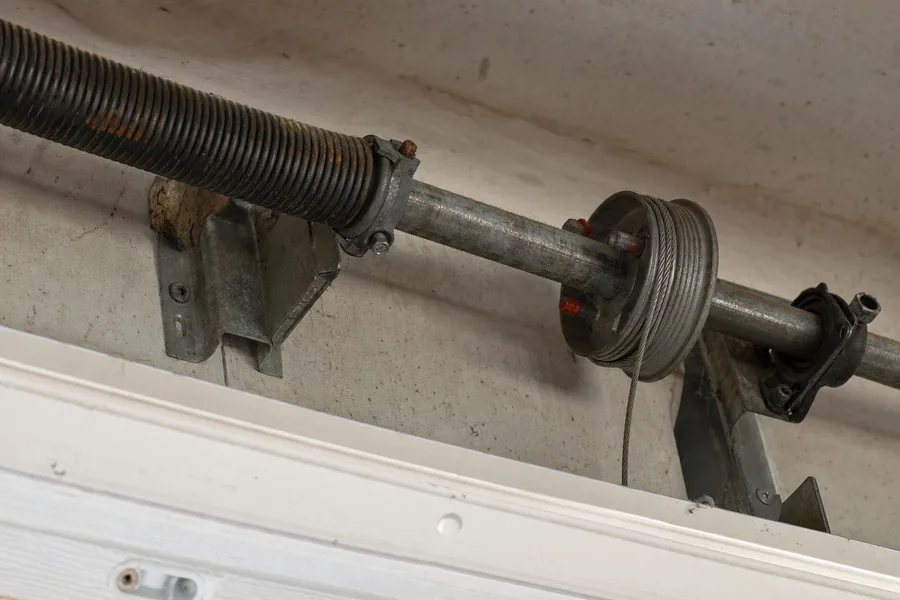
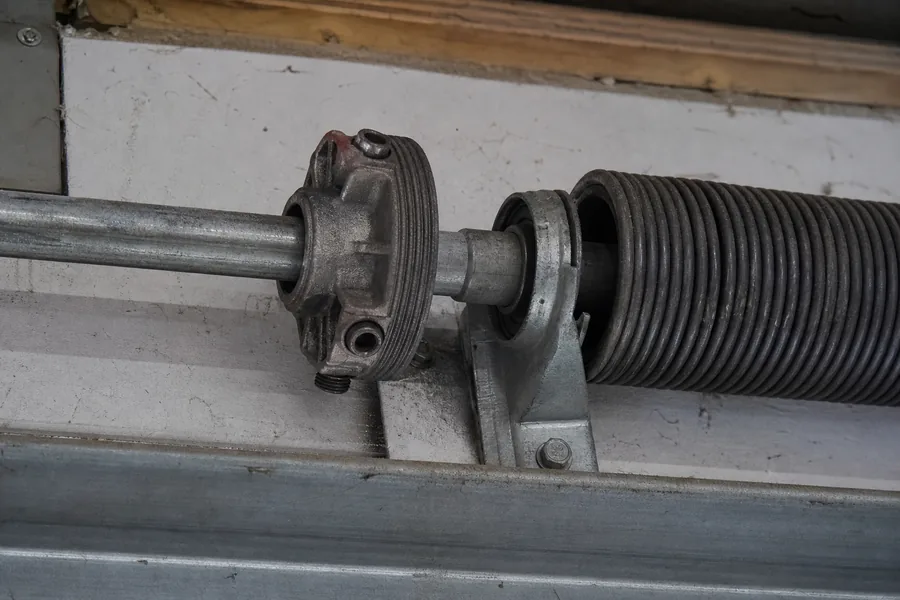
The neighbors usually call it a gunshot or a very hard car-door slam. Across Jackson County, it usually happens with nobody in the garage, and often at three in the morning, because steel contracts as the space cools and a spring at the end of its life will choose the coldest hour to let go. Whoever presses the button next finds the motor straining, the door rising two inches, then nothing.
Any of those symptoms and we can usually name the fault within ten minutes of arriving. We don't guess over the phone, and the estimate is free.
If a garage door job is going to hurt somebody, it's this one. There's enough energy in a wound spring to break a hand, and that load has to be held as it is released. It's not a matter of being careful. The right equipment, and experience of how the load behaves. That's what it takes.
Once a door has failed, stop using it. That's the rule. Run it again and the load lands on hardware never meant to take it. Every attempt makes the job larger.
If the car can't wait, release the opener by the red cord only when the door is completely down, and lift with both hands, back straight. If the door doesn't move easily, leave it. It's telling you the counterbalance is gone.
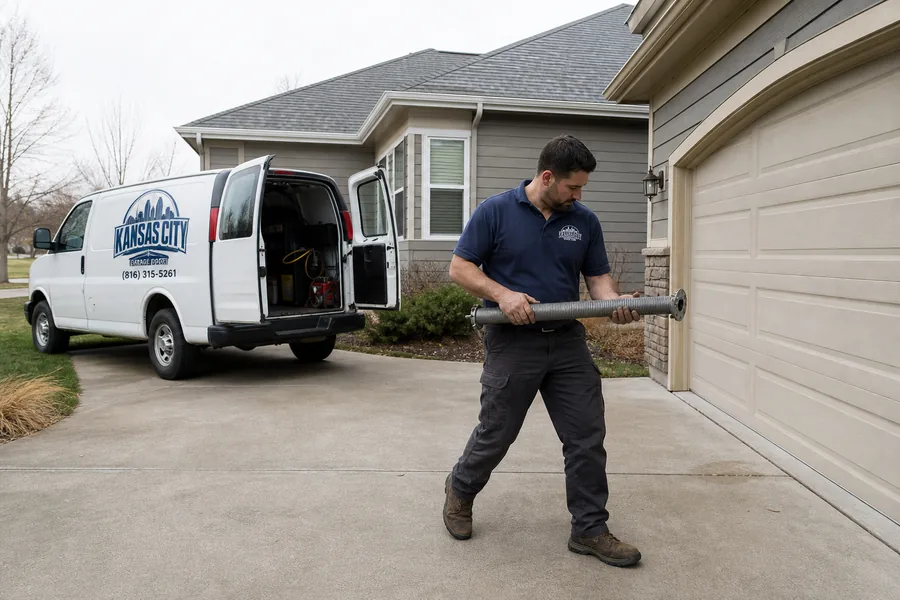
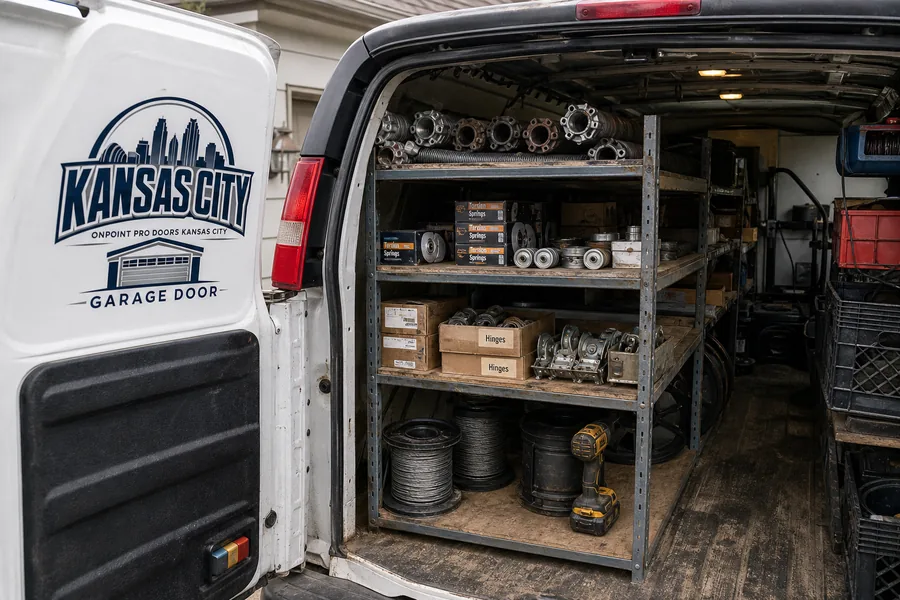
Most people wait. This is what waiting looks like. None of the following is unusual. It's the ordinary sequence, and we see it in Kansas City every week.
It's a free estimate. Finding out asks nothing of you. That alone is reason enough to call before it gets worse.
You can, and we will if that's what you want. Replacing just the broken spring works, until the other one, which has done the same number of lifts, goes too, and you're booking the job all over again. We show you both and let you choose.
A spring can be wrong in both directions. Too much lift is no better than too little. The door drifts open by itself, the opener struggles to pull it closed, and the safety reversal stops behaving. The right spring is the one that matches the door's weight, not the one that beats it.
It almost never does. The spring is a wear item on a door that lasts twenty to thirty years; replacing it is a routine job on a door that is otherwise fine. Somebody who recommends a new door before checking the panels hasn't diagnosed anything yet.
None of that is unique to Kansas City. A door judged by phone gets judged wrong. Our rule is simple: nobody commits to anything until a technician has seen it.

The rating on a home torsion spring is cycles, never years. Most doors come with a 10,000-cycle spring, one cycle being one trip up and one down. Four trips a day is roughly 1,460 cycles a year. The math says seven years. A busy household, two adults working and a teenager driving, can double the count and lose the spring in three.
Wire gauge, inside diameter, length. Those three numbers are the spring. All three must match the weight of your door, which is why the technician measures the old spring and, if in doubt, weighs the door. A near-enough spring will lift it. It will also wear out early, and the labor gets done twice.
Two springs on one door age as a pair. If one has gone, the other is at the same stage of its life and usually only weeks behind. Replacing one and leaving the other means the same labor twice, so we show you both and let you decide with the facts in front of you.
Usually, yes. We hold same-day slots for Kansas City and the surrounding towns, and a door stuck open or a car shut in goes to the front of the list.
If a spring or cable has failed, no. Leave it down and don't force it. The counterbalance stores a lot of energy, and it can release without any warning.
Both springs have the same mileage. The unbroken one is close behind, and replacing it now saves a second visit for the same fault a month later. You see both before deciding.
Springs are rated in cycles, not years. When the count runs out it happens on a normal morning, and there's usually no warning sound or sag beforehand.
Yes. We come out and tell you what has failed, anywhere in Jackson County, with no obligation either way.
Yes, around the clock. Call at 2am with a door that won't close or a car shut in and a technician comes out that night.
If the door in your Kansas City garage is doing any of the things on this page, the fastest route to an answer is a phone call. Tell us what the door is doing and we'll say honestly whether today is necessary.
No call center, and no obligation. We cover Kansas City and Overland Park, Olathe, Lee's Summit, Independence, Liberty, Shawnee.
Just a name, a number, and a line about the door. Everything before you agree to it asks nothing of you, across the whole of Jackson County.
Prefer to talk it through? Call (816) 315-5261.
Tell us what the door is doing. The estimate is free and you can say no.