
Why Won't My Garage Door Open? 12 Causes and Fixes for Kansas City Homeowners
Written by the OnPoint Pro Doors KC team · Updated May 10, 2026 · 8-minute read
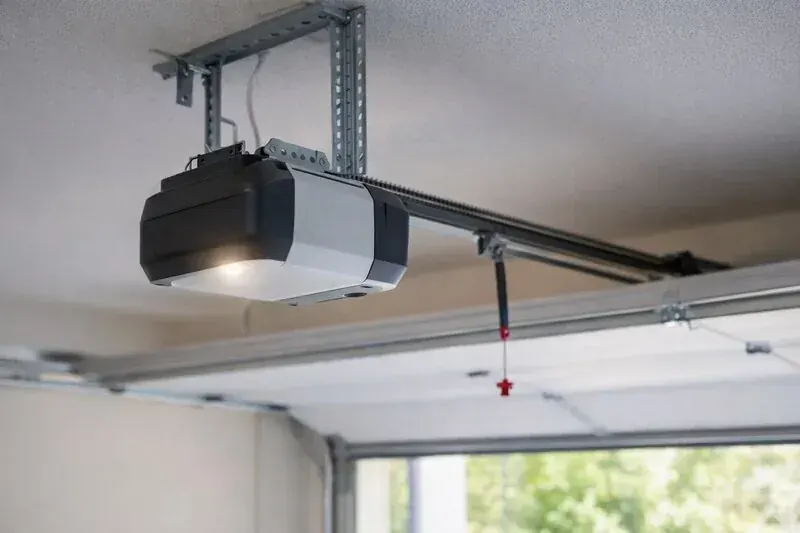
Your garage door won't open. The most common reason in Kansas City is one of three things: a broken torsion spring (you probably heard a loud bang), dead remote batteries, or misaligned safety sensors at the bottom of the tracks. About one in three "won't open" calls we get is fixed in five minutes by the homeowner once they know what to check.
QUICK ANSWER
If your garage door won't open, check four things in this order: (1) press the wall button inside the garage to rule out a dead remote, (2) confirm the opener has power and the GFCI outlet isn't tripped, (3) check that both safety photo-eye sensors near the floor show solid green LEDs, and (4) look up at the torsion spring for a visible gap. Most KC repairs is quoted in person, free and are done same-day.
Door stuck open? Spring snapped? Storm damage?
OnPoint dispatches same-day across all of Kansas City Metro. Free written estimate before any work.
The 12 Most Common Causes (Ranked by How Often We See Them in KC)
After thousands of repair calls across Overland Park, Lee's Summit, Olathe, Blue Springs, Independence, Liberty, and Kansas City proper, here is the actual frequency ranking of what causes a residential garage door to stop opening. We've ordered this list from "fix it yourself in five minutes" down to "call a pro before someone gets hurt."
1. Dead remote battery (about 22% of calls)
By far the most common cause. The remote sits in a hot KC car for years; the CR2032 or 9V battery slowly drains. The wall switch inside the garage works fine, but the remote does nothing — or only works from one foot away. Fix: Replace the battery (under a free written estimate at any hardware store). If a fresh battery doesn't restore range, the remote may need to be reprogrammed to the opener — most modern LiftMaster and Chamberlain units take about 30 seconds following the procedure printed on the motor unit's label.
2. Misaligned safety sensors (about 18% of calls)
Federal law has required photo-eye sensors on every residential opener since 1993. They sit four to six inches above the floor on each side of the door. If one gets bumped — by a basketball, a bike tire, even a Roomba — the door will refuse to close (and on some models, refuse to open). Fix: Wipe both lenses with a soft cloth, then gently bend the brackets by hand until both LEDs glow solid (not blinking). KC garages with raised concrete or settled floors sometimes need the sensors re-shimmed after a few seasons.
3. Broken torsion spring (about 17% of calls — the "gunshot bang")
If you heard a loud bang from the garage and now the door won't budge — or only opens about six inches before reversing — your torsion spring is broken. Standard residential springs are rated for 10,000 cycles, which works out to seven to twelve years for most KC families. The first hard cold snap in December or January is when most snap; the spring's steel is most brittle below 20°F, and the kinetic shock of a heavy door starting to lift is the failure point. Do not force the door. The opener will burn out trying. The fix is professional spring replacement; we always recommend replacing both springs at once because the second one is at 90%+ of its lifespan. Spring replacement details and pricing →
4. Tripped GFCI outlet or breaker (about 9% of calls)
Most KC homes built after 1990 have the garage opener wired through a GFCI outlet that's daisy-chained to exterior outlets. A wet hose bib in spring or a Christmas-light short trips it, and the opener loses power without you realizing why. Fix: Look at the outlet the opener is plugged into and any other GFCI outlets in the garage or on the home's exterior. Press "Reset." If it trips again immediately, you have a short somewhere on the circuit and need an electrician.
5. Manual release cord pulled (about 7% of calls)
The red emergency-release cord hangs from the trolley on the rail. If someone pulled it (kids, a power-outage workaround, a contractor), the trolley is disconnected from the chain or belt — the motor runs, the chain moves, the door doesn't. Fix: With the door fully closed, pull the red cord sharply toward the motor unit until you hear a click. Then run the opener once with the wall switch — the trolley should re-engage automatically.
6. Wall-control vacation/lock mode (about 5% of calls)
Modern wall stations have a "lock" or "vacation" button that disables the remotes (a security feature). It's easy to bump it. The wall switch still works; remotes do nothing. Fix: Look at the wall control for a small "lock" indicator or a button labeled VAC. Press it once to disable.
7. Frozen bottom weatherseal (winter only — about 4% of KC calls)
Specific to Kansas City winters and a real season-killer in the December-February stretch: melt water runs under the door, freezes overnight, and welds the rubber seal to the concrete. You press the opener, the door tries to lift, the motor strains and either reverses (if the force-limit is set right) or rips the seal off the bottom rail. Fix: Pour warm — not boiling — water along the seal. Once it releases, dry the slab and use a thin ice melt designed for concrete (not rock salt, which corrodes the bottom of steel doors). For details, see our KC frozen-door guide.
8. Snapped lift cable (about 4% of calls)
The thin braided steel cables on each side of the door carry the door's weight against the springs. They fray near the bottom drum from KC humidity and salt-air corrosion (yes, even inland), and eventually one snaps. The door tilts crookedly, often jamming in the track. Do not operate the door. Cable replacement is not a DIY job — the springs have to be unloaded first, and the tension is dangerous. Cable repair pricing →
9. Off-track door (about 4% of calls)
Common after a bumper kiss from an SUV pulling out, after a roller fails on a 25-year-old door, or after high winds during a KC severe-weather event. The rollers leave the track; the door hangs crooked and won't move. Do not pull on it. A door that's already off-track can fall the rest of the way during a recovery attempt. Off-track repair is quoted in person, free and takes 60–90 minutes. Off-track repair details →
10. Stripped opener drive gear (about 4% of calls)
Classic LiftMaster and Sears/Chamberlain symptom: motor hums for several seconds, nothing else happens, then the motor stops with a click. Inside the opener housing, a small nylon drive gear has stripped its teeth. Common after 8-12 years of use, especially on chain-drive openers that have been fighting a partly-stuck door (see #7 frozen seal — repeated strain accelerates gear wear). Fix: Replacement gear kit, about a free written estimate (installed price quoted in person). If the opener is over 15 years old, full opener replacement may be the better value.
11. Storm/wind damage (April–June, KC tornado alley)
Kansas City sits in tornado alley, and severe wind events from April through June regularly damage garage doors across Johnson County, Jackson County, and Wyandotte County. Common storm damage modes: a panel buckled inward by wind pressure, a door pushed off its tracks by 70-mph gusts, a panel cracked by flying debris (tree limbs, hail), or a snapped cable from the door slamming. Most homeowners' insurance covers wind and hail damage to garage doors — we document the damage with photos for your claim and can secure or board the opening same-day. See our KC insurance-claim guide.
12. Surge-damaged opener logic board
After a KC thunderstorm, lightning surges through the home's wiring and fries the opener's circuit board. The unit is completely dead — no LED on the wall control, no response from the wall button. Logic-board replacement is possible on premium LiftMaster and Genie units; on bargain-tier openers, full replacement is usually more cost-effective. A good surge protector dedicated to the opener circuit prevents this.
Kansas City Repair Costs (2026)
All pricing below is based on actual KC-metro service calls in the past 12 months. We always provide a fixed written estimate before any work begins. There is no service-call fee when work is authorized; if you decline the estimate, you owe nothing.
Free Estimate — No Charge for Visit
We quote every job in person, free, with no obligation. There is no trip fee and no charge for the diagnostic visit. You get a written estimate before any work starts.
Call (816) 315-5261 for your free estimate.
Payment: cash, check, all major credit cards, debit, Zelle, ACH. No payment until work is complete and you've approved. After-hours emergency calls (10pm–7am, holidays) add 25%. For a full breakdown see our KC garage door cost guide.
Safe DIY Checks (5-Minute Diagnostic)
Run through this checklist before you call. About one in three "won't open" issues in KC is solved here, and even when it isn't, you'll save the technician 10 minutes and yourself a smaller invoice.
- Press the wall switch inside the garage. Door responds = your remote is the problem (battery or programming). Door does nothing = continue.
- Confirm the opener has power. Look at the LED on the motor unit and the wall switch. No LEDs = check the GFCI outlet (press Reset) and the breaker panel.
- Look at the photo-eye sensors. Both LEDs solid = sensors OK. One blinking = wipe lenses, then realign by hand until both are solid.
- Check the manual release. If the motor runs but the door doesn't move, pull the red cord toward the motor until it clicks back into place.
- Look at the wall-control panel for a "Lock" or "Vacation" indicator. Press to disable.
- Look up at the torsion spring. A visible gap, separated coil, or a spring that's clearly in two pieces = stop and call. Do not try to lift the door.
- In winter: check the bottom seal for ice. Pour warm water along the seal.
SAFE TO DIY
Battery replacement, remote programming, sensor cleaning & realignment, manual-release reset, breaker reset, ice removal, weatherseal replacement, lubricating hinges and rollers (silicone or white lithium grease — never WD-40).
CALL A PROFESSIONAL
Spring replacement (200+ lbs of stored tension — these have killed people), cable replacement, off-track door, storm/impact damage, opener gear or board failure, or any door that won't lift after the 5-minute checklist. The cost difference is small. The risk difference is enormous.
Why KC Conditions Make Some Failures More Common
Kansas City's climate puts more stress on garage doors than most US metros. Three KC-specific factors drive the failures we see most often:
Wide annual temperature swing. A KC garage door cycles between 0°F in January and 95°F+ in July. Steel expands and contracts, lubricants thicken and thin, weatherseals harden and crack, and torsion-spring steel becomes more brittle below 20°F. The first arctic blast of December is when our phone rings hardest — broken springs all weekend long. The fix is a fall tune-up: lubrication, hardware tightening, and a balance check. Annual tune-up details →
Severe-weather season. April through June is tornado and large-hail season across the metro. We see a measurable spike in storm-related calls in Overland Park, Lee's Summit, Blue Springs, and Independence — bent tracks from wind, panels cracked by hail, doors pushed inward by gusts. Most of this is covered by homeowners' insurance.
Older housing stock with non-standard openings. Many homes in older Northland, Brookside, Waldo, and downtown KC neighborhoods have 7-foot openings with carriage-house or wood doors that weigh 250+ pounds. The springs and openers in these homes work harder than the suburban-standard 130-pound steel door, and parts wear faster. If you're in one of these neighborhoods and your door is on its original springs after 12+ years, schedule a balance check before the spring snaps on its own.
When You Should Repair vs. Replace
A garage door that won't open is sometimes a symptom of a door that's at end-of-life. Honest rule of thumb after 20+ years in this trade:
- Repair if the door is under 15 years old, panels are intact, and the failed component (spring, cable, opener) is the only major issue. You'll get another 5–10 years.
- Replace if the door is 20+ years old, has been off-track multiple times, has visible panel damage from impacts or weather, or the repair quote exceeds 50% of new-door cost. Modern insulated doors saves money/year on KC heating and cooling and add 4% to home resale value.
- Replace the opener (not the door) if the door itself is fine but the opener is over 15 years old and just had a major failure. Modern openers are quieter, safer, and have battery backup — useful when KC summer storms knock out power.
If a free written estimate repair will get you another 5–7 years out of your existing door, that's what we recommend — even though replacement would generate more revenue for us. Free estimates make it easy to get a real, honest comparison. New-door installation pricing and options →
Frequently Asked Questions
My garage door opens a few inches and stops — why?
Almost always misaligned safety photo-eye sensors at the bottom of the tracks (clean the lenses and align until both LEDs are solid green), or travel-limit settings on the opener (the door "thinks" a few inches is fully open — adjust the up-limit screw on the back of the motor unit), or a binding track or worn roller. KC summers can also cause weatherseals to swell and stick to hot concrete. If five minutes of these checks doesn't fix it, schedule service.
Why does my garage door work fine then suddenly not open?
Sudden total failure usually means power loss (tripped GFCI), a snapped torsion spring (you'll hear a gunshot-like bang), a stripped opener gear (motor hums but nothing moves), or surge damage to the opener after a KC thunderstorm. Test the wall switch first — if it also does nothing, it's almost always power or opener-related.
Is it safe to force open a garage door that won't lift?
No. A residential garage door weighs 130–350 pounds; the springs counterbalance that weight. With a snapped spring, the full weight is on the cables, the opener, or your hands. Lifting can drop the door, snap the second cable, strip your opener, or cause serious injury. Look up at the spring — a visible gap or separated coil means do not operate the door.
Can a Kansas City storm or tornado damage my garage door?
Yes — and KC's tornado season (April through June) sees a real spike in storm-related calls. Wind damage shows up as bent tracks, a buckled or cracked panel, a door pushed off its tracks, or a snapped cable. Most homeowners' insurance covers wind and hail damage to garage doors. We document everything with photos for your claim.
Should I try to fix a garage door spring myself?
No. Torsion springs hold 200+ pounds of stored energy. Spring replacement requires correctly sized winding bars, knowledge of inch-pounds-per-turn for your specific door weight, and a balance test after install. Spring replacement in KC is quoted in person, free; the cost difference between DIY and a pro is small, and the risk difference is enormous. Sensor cleaning, battery swaps, and lubrication are fine to DIY. Springs and cables are not.
Do you serve all of KC metro?
Yes — Overland Park, Lee's Summit, Olathe, Blue Springs, Independence, Liberty, Lenexa, Shawnee, Mission, Prairie Village, Leawood, Gladstone, Raymore, Raytown, Grandview, Belton, Kansas City proper (both MO and KS sides), and all surrounding cities and counties. Same-day service across the metro. See our full KC service area list for your specific city.
How much does it cost to fix a garage door that won't open?
Most KC repairs fall in a free written estimate range depending on the cause. See the cost table above for a full breakdown. We quote a fixed price in writing before starting work. No service-call fee when work is authorized.
What forms of payment do you accept?
Cash, check, all major credit cards (Visa, MC, Amex, Discover), debit, Zelle, and ACH. No payment until work is complete and you've approved.
Garage Door Still Not Opening?
Same-day service across all of Kansas City Metro. Free written estimate. No service-call fee. Serving Missouri and Kansas.
Call (816) 315-5261Sun–Thu 24/7 · Fri 24/7 · 24/7 Emergency
Need more help? See our emergency garage-door tips, KC pricing guide, 24/7 emergency dispatch, or full FAQ.