
EF1, EF2, EF3 Tornado Wind Speeds: What Your Kansas City Garage Door Actually Survives
By the OnPoint Pro Doors KC team · Updated May 11, 2026 · 8-minute read
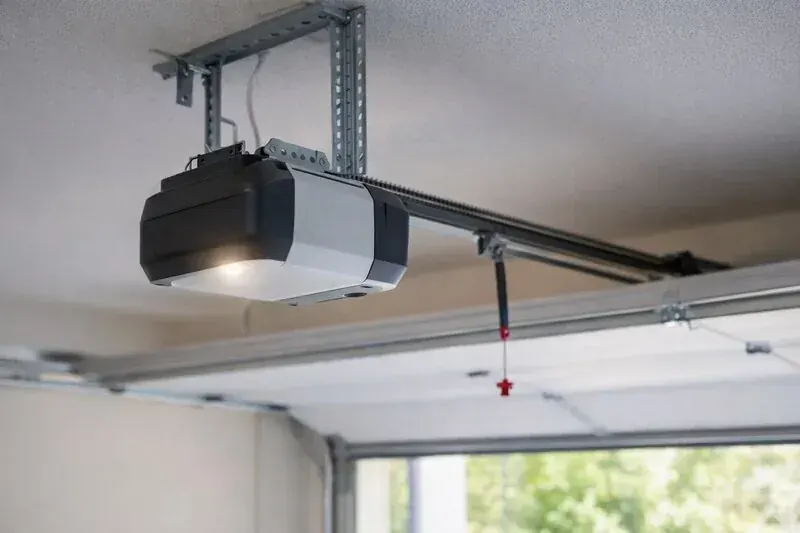
Kansas City sits in tornado alley, and the metro experiences EF1 through EF3 tornadoes nearly every year between March and June. Every spring KC homeowners ask the same question: "Will my garage door survive the next one?" The honest answer depends on your door's age, gauge, reinforcement, and wind-load rating. This guide walks through exactly what happens to a typical residential garage door at each EF-scale wind speed, what counts as a wind-rated door, what reinforcement options actually move the needle, and which KC neighborhoods are most exposed to tornado-track frequency.
QUICK ANSWER
A standard 25-gauge non-reinforced steel garage door (the most common type in KC pre-2000 homes) typically buckles between 80 and 95 mph wind — below the bottom of EF1 (86 mph) when wind hits the door directly. A 24-gauge insulated door with horizontal bracing survives to roughly 110 mph (low EF2). A wind-rated door (Florida-spec 110 to 150 mph rating) survives most EF2 and some EF3 events. Above 165 mph (EF4+), no residential door survives intact. KC homeowners in tornado-track zones should reinforce or upgrade if their door is pre-2000 and non-reinforced.
Worried about your KC garage door in tornado season?
OnPoint dispatches same-day across all of Kansas City Metro — Overland Park, Lee's Summit, Olathe, Shawnee, Liberty, Independence, Lenexa, Leawood, Prairie Village, Raytown, Blue Springs, and KCMO. Free written estimate before any work.
Why Garage Doors Are the EF Scale's Best-Documented Damage Indicator
The Enhanced Fujita scale, adopted by the NWS in 2007, uses 28 different damage indicators to estimate tornado wind speed. Each indicator has specific damage thresholds at each EF level. Residential garage doors are damage indicator #2 ('one- or two-family residence') with sub-criteria for door failure.
Garage doors are useful EF indicators because: they're the largest single opening on most homes, they're consistently engineered (gauge, panel design, hinge spacing), they fail at predictable wind pressures, and the failure mode (inward buckling) is visually distinctive in damage surveys.
This means: when the NWS-EAX team (the Pleasant Hill office covering KC metro) surveys a tornado track and finds a residential garage door buckled inward, that tells them the wind at that spot was at least 90 mph — lower-bound EF1. If they find a wind-rated door buckled, they can infer EF2+ winds. The EF scale rating you see in the news after a KC tornado was partly determined by what your neighborhood's garage doors did.
EF0: 65 to 85 mph — What Your KC Garage Door Sees
EF0 winds rarely damage residential garage doors directly. Indirect damage is more common: a flying tree branch hitting the door, a lawn chair tossed into the panel, hail at peak intensity causing dimples or skin tears.
Typical damage at EF0: Cosmetic dents, weatherseal tears, occasional photo-eye sensor knocked out of alignment, debris impact dings.
Survival rate: 100% of properly-installed garage doors of any age survive direct EF0 winds without structural failure.
Action after EF0 storm: Inspect for cosmetic damage and sensor alignment. Most doors operate normally afterward.
EF1: 86 to 110 mph — The First Real Test
EF1 winds are the threshold at which standard residential garage doors begin to fail. The lower half of EF1 (86 to 95 mph) damages older or thinner doors; the upper half (100 to 110 mph) damages most non-reinforced standard doors.
Standard 25-gauge non-reinforced door (most KC pre-2000 homes): Buckles inward when wind hits face-on at 80 to 95 mph. Once the door buckles, internal home pressure spikes and the wind has unrestricted access to the roof and walls. This is the primary failure mode that causes total roof loss in EF1 to EF2 KC homes.
Standard 24-gauge insulated door (most KC 2000-2015 homes): Survives most EF1 winds up to about 105 mph. Beyond that, lower-EF2 winds begin to buckle.
Wind-rated door (Florida-spec 110 mph): Designed exactly for this range. Survives all of EF1 and the bottom of EF2.
⚠️ SAFETY WARNING
EF2: 111 to 135 mph — Most KC Standard Doors Fail
EF2 is where the majority of standard residential garage doors fail. Reinforced or wind-rated doors fare significantly better.
Standard 25-gauge non-reinforced door: Almost always fails — if it survived EF1 winds earlier in the same event, it usually doesn't survive EF2. Failure is dramatic: inward buckling of all panels, panels separating from each other at the hinges, partial or total separation from the tracks.
24-gauge insulated door: Roughly 50% failure rate at mid-EF2 (120 mph) winds. Brace kits installed before the storm raise this survival rate to about 70%.
Wind-rated door (110 mph spec): Roughly 60% survival rate at low-EF2 winds, dropping to 25% at high-EF2.
Wind-rated door (140 mph spec): 90% survival through all of EF2. Some panel damage and weatherseal tears, but the structural integrity holds.
Hurricane-rated door (150 mph FBC): Essentially 100% survival through EF2.
EF3: 136 to 165 mph — Hurricane-Rated Territory
EF3 winds are catastrophic for most residential structures. Garage door survival depends entirely on the rating.
Any non-rated door: Almost certain failure. Total breach of the garage opening.
Wind-rated 110 to 130 mph: Most fail. The door is being subjected to wind pressures 30 to 50% above its design rating.
Wind-rated 140 mph: About 40% survival rate at low-EF3 winds, much lower at high-EF3.
Hurricane-rated 150 mph FBC: About 75% survival at mid-EF3. Even when the door itself holds, the surrounding wall framing may fail at these wind levels — door survival doesn't guarantee home survival.
Reality check: At EF3+ winds, structural failure modes other than the garage door (roof lift, framing pull-out, wall buckling, foundation displacement) become equally common. A surviving garage door on a destroyed house is small comfort.
EF4 and EF5: 166+ mph — Nothing Stays Intact
Above 165 mph wind, no standard residential garage door survives, regardless of rating. The highest-rated Florida hurricane doors are tested to 200+ mph, but at that wind level the entire house structure is failing too.
KC has experienced multiple EF4 tornadoes in the broader region (Joplin 2011 was an EF5; Greensburg, KS 2007 was an EF5). The metro itself has seen tracks ranging up to EF3 in recent decades, with EF4+ being statistically rare but not impossible.
Wind-Survival Summary by Door Type
Free Estimate — No Charge for Visit
We quote every job in person, free, with no obligation. There is no trip fee and no charge for the diagnostic visit. You get a written estimate before any work starts.
Call (816) 315-5261 for your free estimate.
PRO TIP
The single biggest performance jump per dollar is from 25-ga non-reinforced to 25-ga + brace kit — a modest investment that adds 15 to 20 mph of wind survival. If you can't afford a full upgrade, install a brace kit before tornado season. We do this in 60 to 90 minutes for a free written estimate (installed price quoted in person).
KC Tornado-Track Risk by Geography
Historical NWS-EAX tornado-track data (cumulative since the 1950s) shows these patterns across KC metro:
Highest cumulative track frequency: Wyandotte County (KCK proper, Bonner Springs, Edwardsville), western Johnson County (Olathe, Gardner, De Soto), south Jackson County (Grandview, Belton, Harrisonville corridor), Cass County (Pleasant Hill, Harrisonville), and the I-70 corridor through Independence, Blue Springs, and Oak Grove.
Moderate track frequency: Most of the metro core. Tornado tracks have crossed every KC zip code at some point in recorded history, but the cumulative count is lower in the central KCMO urban core (suspected to be due to a slight 'urban heat island' deflection, though this is debated).
Lower track frequency: Far northern Clay and Platte counties (Smithville, Parkville), where the river valleys appear to deflect some lower-altitude tornado tracks. Still not zero.
Practical takeaway: if you live in Wyandotte, western Johnson, south Jackson, or Cass counties and your garage door is non-reinforced, the wind-mitigation upgrade pays for itself in expected-value terms across a 20-year homeownership horizon.
What We Recommend for KC Tornado-Zone Homeowners
Based on hundreds of post-storm jobs and tornado-zone upgrades across KC metro:
- If your door is pre-2000 and non-reinforced: upgrade. A 24-gauge insulated door with internal bracing or a wind-rated FBC door is the right answer. is quoted in person, free (installed price quoted in person). ROI is in the form of avoided losses, not direct savings.
- If your door is post-2000 modern and non-reinforced: add a brace kit. a free written estimate (installed price quoted in person). Best per-dollar wind-survival upgrade you can buy. We do this in 60 to 90 minutes.
- If you're already replacing a door for other reasons: pay the wind-rated upgrade premium. The marginal cost over a standard door is a free written estimate. For a 20-year door life in a tornado zone, this is a no-brainer.
- Get manufacturer wind-rating certification. We provide this paperwork with every wind-rated install. State Farm and American Family in Missouri offer wind-mitigation credits when you present this documentation.
- Don't forget the other openings. Wind-rated garage door + non-rated entry door = the entry door becomes the new weak link. Holistic envelope thinking pays off.
OnPoint Pro Doors carries Clopay, Amarr, Wayne Dalton, and Haas wind-rated and hurricane-rated doors in our KC warehouse. Free in-home consultation and written estimate. We're Warrantied in MO and KS and pull permits in every metro jurisdiction.
Frequently Asked Questions
What is the Enhanced Fujita (EF) scale and how does it apply to garage doors?
The Enhanced Fujita scale rates tornado damage on a 0-to-5 scale based on observed damage and inferred 3-second wind gusts. EF0 is 65 to 85 mph; EF1 is 86 to 110 mph; EF2 is 111 to 135 mph; EF3 is 136 to 165 mph; EF4 is 166 to 200 mph; EF5 is above 200 mph. Garage doors are one of the standard 'damage indicators' on the EF scale because their failure threshold is well-characterized: a typical residential door failure indicates EF1 or higher winds at that specific location.
At what wind speed does a typical Kansas City garage door fail?
Standard 25-gauge non-reinforced steel doors (most common in pre-2000 KC homes) fail between 80 and 95 mph when wind hits the door face-on. This is below the EF1 threshold. 24-gauge doors with horizontal bracing fail to 115 mph (within EF1 to low EF2). Wind-rated doors (Florida-spec, 110 to 150 mph) fail to 155 mph (EF2 to low EF3). Above 165 mph (high EF3 and above), no residential door survives intact regardless of rating.
Does the direction of the wind matter to garage door survival?
Yes — significantly. Wind hitting the door face-on (perpendicular to the door surface) generates positive pressure that buckles the door inward. Wind hitting the door from the side or angled at less than 45 degrees generates less pressure and is less damaging. KC tornado tracks tend west-to-east or southwest-to-northeast, so south-facing and west-facing garage doors are at higher risk than north-facing or east-facing doors.
What's the difference between wind-rated and standard garage doors?
Wind-rated doors are engineered and tested to meet specific wind-pressure ratings, typically following Florida Building Code standards (FBC). Common ratings: 110 mph, 130 mph, 140 mph, 150 mph (corresponding to Florida wind zones). They use thicker gauge steel (often 24-gauge or heavier), continuous internal horizontal bracing, reinforced hinges, and stronger track-to-wall fastening. Cost premium over standard doors: typically a free written estimate depending on size and rating.
Can I reinforce my existing KC garage door instead of replacing it?
Yes — horizontal brace kits are available for most major brands (Clopay, Amarr, Wayne Dalton). A typical kit installs across the back of each panel, adding rigidity against face-on wind pressure. Cost: quoted free in person installed. Effectively raises the door's wind-survival threshold by 15 to 30 mph — meaningful in the EF1-to-EF2 transition zone. Less helpful at EF3+ where the entire door, frame, and home structure are being stressed.
Which KC neighborhoods are at highest tornado-track risk?
Historical tornado-track data from NWS-EAX (the Pleasant Hill office serving KC metro) shows tracks have crossed every part of the metro at some point. Specific high-frequency zones over the last 40 years: Wyandotte County (KCK proper, Bonner Springs), western Johnson County (Olathe, Gardner), south Jackson County (Grandview, Belton, Harrisonville corridor), and the Independence-to-Blue Springs corridor along I-70. No KC zip code is tornado-free.
Does my insurance discount apply if I install a wind-rated garage door?
Sometimes — depends on carrier and state. State Farm and American Family both offer Wind Mitigation Credits in Missouri (typically 5% to 15% discount on the wind portion of premium) when the homeowner installs FBC wind-rated doors AND provides certification documentation. Kansas wind/hail policies are more variable; ask your specific carrier. Always document the install with manufacturer wind-rating certification — without that paperwork, no credit.
Should I consider a hurricane-rated garage door for tornado country?
Florida hurricane-rated doors (FBC-tested to 150 mph or higher) are over-engineered for typical KC tornado-track winds, but they're not over-priced — the cost premium is similar to a standard wind-rated door, and the engineering margins are higher. For homes in known tornado-track corridors (Wyandotte County, western JoCo), a 150-mph FBC-rated door is overkill in 95% of years and exactly right in the 1-in-20 year that matters.
Upgrade Your Door Before Tornado Season Peaks
Same-day service across all of Kansas City Metro — Overland Park, Lee's Summit, Olathe, Shawnee, Liberty, Independence, Lenexa, Leawood, Prairie Village, Raytown, Blue Springs, and KCMO. Free written estimate. No service-call fee. Warrantied in Missouri and Kansas.
Call (816) 315-526124/7 Emergency · service@onpointprodoors.com
Related: Tornado warning playbook → · Post-tornado inspection → · New door installation → · KC insurance claim →