
The Kansas City Post-Tornado Garage Door Inspection Checklist: 14 Points, Photo Documentation, and Repair-vs-Replace Decision Tree
By the OnPoint Pro Doors KC team · Updated May 11, 2026 · 9-minute read
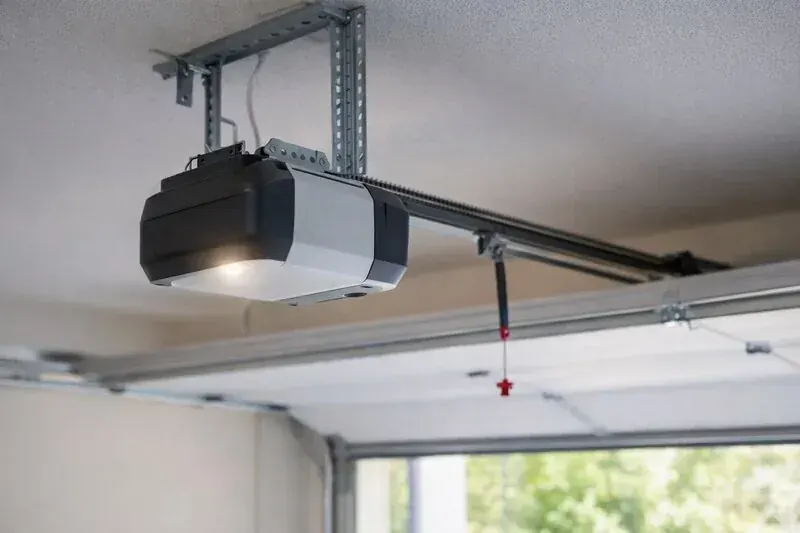
After a tornado, severe thunderstorm, or microburst in Kansas City, your garage door is one of the first structural openings you should inspect — before you re-open it. A door that looks okay from the outside can have invisible track damage, fractured panel skins, fraying cables, or a partially-released spring that will fail on the next cycle. KC's April-through-June severe weather season produces multiple high-wind events every year, and the metro saw confirmed EF1 through EF3 tornadoes in 2024, 2025, and twice already in 2026. Here's exactly how to inspect your door, document the damage for your MO or KS insurance carrier, and decide whether to repair or replace.
QUICK ANSWER
Storm damage to your KC garage door? Don't operate it.
OnPoint dispatches same-day across all of Kansas City Metro — Overland Park, Lee's Summit, Olathe, Shawnee, Liberty, Independence, Lenexa, Leawood, Prairie Village, Raytown, Blue Springs, and KCMO. Free written estimate before any work.
Why a Quick Visual Inspection Isn't Enough After a KC Tornado
A garage door that survives a tornado without visible damage has often sustained invisible damage. The wind pressure that buckles a panel can also bend a track 1/8 inch (enough to misalign rollers), partially release spring tension (enough to fail on the next morning's cycle), or fray a lift cable to 30% capacity (enough to break within 50 more cycles). The 14-point checklist below is designed to find these less-obvious failures before they become injuries.
After EF1 winds (86 to 110 mph), about 20% of garage doors in the affected area show some damage; only half of that is visible from a casual external look. After EF2 (111 to 135 mph), most non-reinforced residential doors show structural damage. After EF3 (136 to 165 mph), most residential doors fail outright.
⚠️ SAFETY WARNING
Do not try to manually lift or operate a damaged door, even "just to see if it works." Cable failures and spring releases can happen on the first cycle after damage. The energy stored in a torsion spring can cause severe lacerations or broken bones at close range.
The 14-Point Post-Tornado Inspection Checklist
Run through this list in order. Document each finding with a photo. If you find more than one issue, stop and call us before operating the door.
1. Panel face from outside
Stand 15 feet back from the door and look across the face. Look for bowing (panel curves inward or outward), cracks in the panel skin, dents from debris, separation at panel-to-panel hinge joints, or paint flaking from impact. Common KC pattern: wind from the west pushes the door inward at the center, creating a slight concave bow.
2. Panel face from inside
Open the door to the half-position (if safe to operate — otherwise inspect closed) and look at the interior face of each panel. Cracks, foam-insulation extrusion, dented steel skin behind insulation, separated panel joints. Critical: any visible crack of more than 6 inches in a panel skin means panel replacement.
3. Tracks — vertical sections
Look up both side rails from floor to ceiling. Tracks should be perfectly straight, parallel to each other, and tightly fastened to the wall with lag bolts every 2 to 3 feet. Findings: bends, twists, separation from wall, missing or loosened lag bolts.
4. Tracks — horizontal sections
Look at the overhead tracks running from the curved portion at the top of the door back into the garage. Same criteria as vertical: straight, parallel, securely fastened. Common storm finding: the horizontal track has been pushed up 1/4 to 1/2 inch by wind pressure transferring through the door panels.
5. Rollers
Look at every roller (typically 10 to 14 per door). Each should be intact, with the stem firmly in the hinge bracket and the wheel rolling smoothly in the track. Storm damage often cracks roller wheels or bends roller stems. Replace any visibly damaged roller before operating.
6. Cables (left and right)
Look at the steel cables running from the bottom corner of the door up to the cable drum near the torsion bar. Cables should be tight, with no visible fraying, no exposed broken strands, and seated correctly in the drum groove. Frayed cables are the highest-risk finding — they fail catastrophically and cause the door to fall.
7. Torsion spring(s)
Look at the spring(s) mounted on the torsion bar above the door. Each spring should be one continuous coil with no visible gap. A gap of 1 inch or more means a broken spring. After a tornado, springs can also be partially released — look for any visible loosening of the spring set screws on the cable drums.
8. Spring anchor bracket
Look at the bracket that mounts the springs to the wall above the center of the door. Lag bolts should be fully seated; the bracket should be flat against the wall with no separation. Storm pressure transferring through the door can rip this bracket partially off the wall.
9. Opener motor mounting
Look at the ceiling-mounted opener (or wall-mounted jackshaft for side-mount installs). The opener should be hanging level, securely fastened to the ceiling or wall, with no visible separation. Check that the rail attached to the opener is straight, not bent or twisted.
10. Photo-eye sensors
Look at the two sensors mounted four to six inches above the floor at the door opening. Both LEDs should glow solid (typically one green, one orange or red — varies by brand). If either LED is blinking or off, sensors are out of alignment from wind movement of the brackets.
11. Header above the door
Look at the framing above the door from the inside of the garage. Look for new cracks in the drywall, plaster, or framing — especially near the corners. A header that's structurally compromised affects every cycle of the door.
12. Bottom weather seal
Inspect the rubber weather seal along the entire bottom edge of the door. Tears, separations, or pieces ripped off mean storm pressure was significant. The seal itself is easy to replace but tells you about wind force.
13. Hinges (across all panel joints)
Look at every hinge connecting adjacent panels (typically 4 to 6 hinges per panel joint). Each should be flat, with no bending, no loose screws, and no separation. Hinge damage is common in EF1+ winds.
14. Bottom bracket and stop bumper
Look at the metal bracket at the bottom corner of the door where the cable attaches. This bracket carries the entire door weight on its cable attachment — it should be flat, with the cable seated correctly. Also check the rubber stop bumpers at the top of each rail — they cushion the door at full-open position.
⚠️ SAFETY WARNING
The bottom bracket is under intense spring tension. Never attempt to loosen, adjust, or remove this bracket yourself. We use specialized tools to unload spring tension before working on it.
Photo Documentation: What KC Insurance Adjusters Actually Want
- Full door from outside — head-on shot. Standing 20 to 25 feet from the garage. Both panels and frame visible in a single frame. Date-stamped or with phone visible.
- Full door from outside — angled shot. From the side at about 30 degrees to highlight any bowing.
- Each damaged panel — close-up. Within 3 feet of the panel showing the specific damage. Include some context in the frame so the location on the door is clear.
- Both tracks — full length. Vertical section and horizontal section, photographed from inside the garage looking along the track.
- All cables and springs. From inside, looking up at the torsion bar. Show both springs and both cable drums in a single shot.
- Opener and rail. From below, showing the opener housing and the full rail length.
- Header area. Looking up at the framing above the door from inside the garage.
- Debris that contacted the door. Tree branches, hail piles, lawn furniture, anything that hit the door. Insurance adjusters care about the cause-of-damage object.
- Storm-report screenshot. Capture the NWS-EAX storm report or wind/hail event matching the date your claim is for. The carrier will verify against NWS data anyway, but providing it speeds approval.
PRO TIP
Save the photo set in a single cloud folder (Google Photos album, iCloud shared folder, Dropbox folder) and share the link with both your insurance adjuster and your garage door contractor. This eliminates back-and-forth requests and accelerates the claim by 3 to 7 days in our experience.
Repair-vs-Replace Decision Tree
After the inspection, you (or your contractor) need to decide whether each finding is repaired in-place or whether the door is replaced entirely.
Lean toward REPAIR when:
Single panel damage on an otherwise sound door under 15 years old. Cable or spring damage with intact panels. Track misalignment or single track bend. Sensor or opener-mount damage. Cosmetic dents that don't affect structure.
Lean toward REPLACE when:
Insurance adjusters in MO and KS will usually approve replacement when 2+ panels are damaged because cosmetic mismatch between new and old panels reduces the home's value — carriers prefer paying for a uniform replacement over a patched door.
KC Post-Storm Pricing Reality (2026)
Free Estimate — No Charge for Visit
We quote every job in person, free, with no obligation. There is no trip fee and no charge for the diagnostic visit. You get a written estimate before any work starts.
Call (816) 315-5261 for your free estimate.
Most Warrantied claims pay the contractor directly via assignment-of-benefits or pay the homeowner who then pays the contractor. Out-of-pocket is just your deductible — typically a free written estimate in MO and 1% to 5% of dwelling coverage in KS wind/hail policies.
Step-by-Step: What to Do in the First 72 Hours After a KC Tornado
- Hour 0-2: Safety first. Ensure your family is safe. Don't operate the door until inspected. If the door is blown out, secure the opening with plywood or tarp as quickly as possible.
- Hour 2-12: Photo-document everything. Walk the 14-point inspection with your phone camera. Capture context and close-ups. Save to cloud storage.
- Hour 12-24: Call your insurance carrier. File the initial claim. You'll get a claim number and (usually) an adjuster assignment within 24 to 72 hours. Provide them the cloud-folder link with your photos.
- Hour 24-48: Call a Warrantied contractor. Call us at (816) 315-5261 for a written professional estimate. We provide this on-site and email it to you in PDF for your adjuster file.
- Hour 48-72: Schedule adjuster + contractor on-site. If possible, have both the insurance adjuster and our contractor on-site at the same time. This eliminates back-and-forth and speeds the approval by 7 to 14 days.
- Hour 72+: Schedule repair / replacement. Once the adjuster approves the claim, schedule the actual work. We typically have parts in stock for the most common KC residential doors and can complete most repairs within 48 to 72 hours of approval.
Why Our Post-Storm Process Gets Claims Approved Faster
OnPoint Pro Doors has supported hundreds of insurance-covered storm damage claims across KC metro. Our written estimates use the exact line-item language that carriers in MO and KS expect, our photo documentation matches adjuster requirements, and we have direct working relationships with the major KC-area adjusters at State Farm, American Family, Shelter, Farm Bureau, and Allstate.
This translates to: claims approved on first submission rather than going back-and-forth for revisions; faster approval timeline (typically 7 to 14 days vs. 21 to 35 days for contractors who don't know the carriers' expectations); and a contractor who can handle the adjuster conversation on your behalf if you're not available.
Our service area for post-storm response is the full KC metro: Overland Park, Lee's Summit, Olathe, Blue Springs, Independence, Liberty, KCMO, Shawnee, Leawood, Prairie Village, Lenexa, Raytown, and surrounding cities and counties on both sides of the state line.
Frequently Asked Questions
How do I know if my garage door is safe to operate after a Kansas City tornado?
Run the 14-point inspection: look for any panel bowing, panel cracks, track bends or separation, frayed cables, spring gaps, opener mount displacement, sensor misalignment, header damage, weatherseal tears, hinge damage, bottom-bracket damage, or stop-bumper damage. If you find ANY two or more findings, do not operate the door. Single findings in non-critical areas (sensor alignment, weatherseal) can usually be operated once carefully. If unsure, call us for a professional inspection — same-day across KC metro.
Will my homeowners insurance cover post-tornado garage door damage in Kansas City?
Yes — both Missouri and Kansas homeowners policies cover wind, hail, and tornado damage to garage doors as part of dwelling coverage. Your deductible applies. Most KC carriers (State Farm, American Family, Shelter, Farm Bureau, Allstate) require date-stamped photos matching NWS storm-report dates, a written professional estimate, and a claim filed within a carrier-specific window (typically 30 to 90 days from event). KS wind/hail policies often have percentage deductibles (1% to 5% of dwelling coverage) which can exceed the cost of the door.
Do I need to photo-document garage door damage immediately after a KC storm?
Yes, the same day if possible. Insurance adjusters expect photos taken within 24 to 72 hours of the event date. Photograph: the full door from outside, the door from inside, close-ups of any visible damage, the tracks from both sides, the springs from inside, the cables, the bottom seal, the opener mounting, and any debris that contacted the door. Date-stamp the photos by including a phone showing the current date in one corner, OR use a phone camera that embeds timestamp metadata.
What does post-tornado garage door repair typically cost in Kansas City?
Depends on damage scope. Simple track realignment after wind pressure: a free written estimate. Single panel replacement: a free written estimate per panel depending on door brand. Multiple panels: usually points to full door replacement at a free written estimate (installed price quoted in person) for residential single-car or double-car. Complete opener replacement after surge damage: a free written estimate. Full door + opener + track + spring after EF1+ direct damage: a free written estimate typical. Most of this is insurance-covered.
Should I repair or replace a garage door damaged in a KC tornado?
General decision rule: replace if 2+ panels are bowed or cracked, OR if the door frame (header) is structurally compromised, OR if the door is 15+ years old AND has any structural damage. Repair if it's a single panel with otherwise sound structure, OR cable / spring / track damage with intact panels. Your insurance adjuster will usually make the final call; we provide repair-or-replace recommendation with cost breakdown for both options.
How fast can you respond after a confirmed tornado in Johnson, Jackson, Wyandotte, or Clay County?
Post-storm response prioritization: (1) homes with doors stuck open (security/exposure risk) within 2 to 4 hours, (2) homes with detached panels or fully blown openings within 4 to 8 hours for board-up, (3) full damage inspections within 24 hours, (4) repair work scheduled within 48 to 72 hours. We typically double-shift dispatch after any confirmed EF1+ tornado in KC metro. Call (816) 315-5261.
Does my garage door insurance claim affect my premium?
Can I open my garage door for the adjuster if it's been damaged?
Only if your inspection of the 14 points confirms it's safe to operate. If you find frayed cables, a spring gap, panel cracks, or track separation, do NOT operate the door for the adjuster — the adjuster does not want a door to fail in their presence either. Send photos in advance, schedule the adjuster visit with a contractor (us) on-site if possible, and we can manually operate the door safely for the adjuster's inspection.
Get a Professional Post-Storm Inspection Today
Same-day service across all of Kansas City Metro — Overland Park, Lee's Summit, Olathe, Shawnee, Liberty, Independence, Lenexa, Leawood, Prairie Village, Raytown, Blue Springs, and KCMO. Free written estimate. No service-call fee. Warrantied in Missouri and Kansas.
Call (816) 315-526124/7 Emergency · service@onpointprodoors.com
Related: Tornado warning playbook → · KC insurance claim guide → · Hail damage service → · 24/7 emergency →