
The Country Club Plaza and Brookside Historic Garage Door Approval Process (Kansas City, 2026)
By the OnPoint Pro Doors KC team · Updated May 11, 2026 · 7-minute read
If you own a home inside the Country Club Plaza, Sunset Hill, Brookside, or Greenway Fields historic districts in Kansas City, replacing your garage door is not a same-day decision. These J. C. Nichols-era neighborhoods, developed between 1908 and 1948, are governed by some of the most aesthetically strict architectural review boards in the Midwest. Carriage-house style is mandatory in most of the district; modern flush-panel and most recessed-panel doors are denied on first submission. Get the approval process right and your install is uneventful; skip it and you can be ordered to remove the door at your expense.
QUICK ANSWER
The Country Club Plaza, Sunset Hill, and Brookside historic districts require Architectural Review Board approval before garage door replacement. The process typically takes 4 to 8 weeks, is quoted in person, free in submission fees, and requires carriage-house style doors in approved colors (Bridgeport, Sandstone, Charcoal, Black). Stamped-carriage and Coachman-style doors from Clopay are the most commonly approved. We submit ARB packages on behalf of our clients in these districts and handle the entire approval-to-install workflow.
Country Club Plaza or Brookside garage door project?
OnPoint dispatches same-day across all of Kansas City Metro — Overland Park, Lee's Summit, Olathe, Shawnee, Liberty, Independence, Lenexa, Leawood, Prairie Village, Raytown, Blue Springs, and KCMO. Free written estimate before any work.
The J. C. Nichols Historic Districts: Why the Rules Exist
Between 1908 and 1948, developer J. C. Nichols laid out what became the Country Club District — an interconnected set of planned residential neighborhoods south of downtown KC that includes the Country Club Plaza, Sunset Hill, Brookside, Crestwood, Greenway Fields, and Country Side. Nichols pioneered the concept of deed-restricted residential development in the United States, and his original deed covenants — updated and codified through what became the Country Club District Homes Association (CCHA) and the various district homes associations — remain in force today.
The architectural review function exists to preserve the character of these neighborhoods. For garage doors specifically, that character is: carriage-house style, dark muted color, solid panel face, and visual deference to the home's primary architectural style. Most homes in the district are Tudor Revival, Colonial Revival, Spanish Eclectic, Mediterranean Revival, or American Foursquare. Modern flush or contemporary doors are visually jarring in these contexts.
PRO TIP
If you own a home in the J. C. Nichols districts and you don't know your exact homes association or ARB structure, start at cchakc.org and look up your address. Each sub-district (Mission Hills, Brookside, Country Side, Crestwood, etc.) has slightly different rules and meeting cadence.
The Eight-Week Approval Timeline (Step by Step)
- Week 1 — Identify your district and ARB. Confirm which homes association governs your address and download the current architectural guidelines. Each district publishes a slightly different guideline document.
- Week 2 — Site visit and measurement. Have a contractor (us, ideally) come measure the existing door and recommend specific manufacturer styles and colors that are likely to be approved.
- Week 3 — Assemble the submission package. Manufacturer spec sheet, color sample, scaled drawing in context, current photos, written narrative, and submission fee. We prepare this package for our clients in the district.
- Week 4 — Submit to the ARB. Most KC historic ARBs accept emailed submissions; some still require paper. Submission deadlines are typically 2 to 3 weeks before the next monthly meeting.
- Weeks 5-6 — ARB review. The ARB reviews at its next monthly meeting. They may approve as submitted, conditionally approve (with required modifications), or deny.
- Week 7 — Approval issued. Approved package becomes the authorization document. Save it for your file and for any future home sale disclosure.
- Week 8 — Order the door, schedule the install. Carriage-house custom doors typically have 2 to 4 week manufacturer lead times. Install scheduled when door arrives at our KC warehouse.
⚠️ SAFETY WARNING
Do not start work before written ARB approval is in hand. "I'll just do it and ask forgiveness" is the single most expensive mistake homeowners make in these districts. If a neighbor reports the unapproved work (and someone always does), the homes association can compel removal of the door at the homeowner's expense, regardless of how recently it was installed.
Approved Door Styles, Colors, and What Actually Gets Denied
Based on our submissions and observations across the J. C. Nichols districts, here is what we see approved and denied most often:
Approved most consistently
Clopay Coachman Collection (Design 13, 14, or 16 with REC13 or REC14 stamping) in Bridgeport, Sandstone, or Charcoal; Amarr Classica Collection in Lucerne or Verona panel designs in Sandtone or Walnut; Wayne Dalton 9405 or 9700 Carriage House series in Almond or Hunter Green; faux-wood finishes (CYPRESS, MAHOGANY) on case-by-case review.
Sometimes approved with conditions
Insulated carriage-house doors with small upper-row windows (4-pane or arched-pane configurations) — ARB often asks for clear or simulated divided-lite glass instead of frosted; modern flush doors when the garage is alley-facing and not visible from the street; non-standard colors (e.g., custom blue, custom gray) with paint chip submission.
Routinely denied
Modern flush-panel doors on street-facing garages; aluminum-and-glass contemporary doors except on architecturally modernist homes (very rare in these districts); bright white, light gray, light blue, or any high-saturation hue; any door without panel detail; oversized windows in any pattern on Tudor Revival and Spanish Eclectic homes.
PRO TIP
If you own a Tudor Revival home in Brookside, Greenway Fields, or Sunset Hill, the Clopay Coachman Design 13 with REC13 stamping in Bridgeport is the single most commonly approved door style we install. It complements the home's stucco-and-half-timber facade without competing with it. We have installed dozens of these and never had one denied by the ARB.
Cost Reality: What Approval-Plus-Install Actually Runs in 2026
Free Estimate — No Charge for Visit
We quote every job in person, free, with no obligation. There is no trip fee and no charge for the diagnostic visit. You get a written estimate before any work starts.
Call (816) 315-5261 for your free estimate.
Total typical project cost in the historic districts: a free written estimate for a single-car install with approved carriage-house door, ARB submission, jackshaft opener, and any required permits. Double-car projects: a free written estimate.
These are higher than commodity stock-door pricing because (a) the doors themselves are custom-finished, (b) the approval process takes paid time, and (c) the homes themselves often have detached or older attached garages with framing issues that take more install time to handle properly.
What We Do Differently for Historic District Clients
OnPoint Pro Doors has worked dozens of installations across the J. C. Nichols districts. We handle the entire approval-to-install workflow: site measurement, manufacturer style recommendation, color chip retrieval, drawing and photo preparation, ARB submission, fee handling, and (after approval) door order and installation.
We carry insurance to operate in CCHA-governed districts and our license numbers are on file with KCMO Building Inspection. Our written work guarantee covers the door and installation; the ARB approval covers the aesthetic compliance.
Most importantly: we tell clients honestly which door styles and colors are likely to be approved. We do not submit doors that we know the ARB will reject — that wastes the homeowner's time and money. If you have a specific style in mind that is unlikely to be approved, we say so and offer alternatives.
PRO TIP
Save your approved ARB documentation in a permanent file. When you sell your home, the buyer's title company will ask for proof of historic-district compliance on any exterior modifications. An approved ARB letter is what satisfies that.
Frequently Asked Questions
Do I really need approval to replace my garage door in the Country Club Plaza district?
Yes. The Country Club Plaza, Sunset Hill, Greenway Fields, and parts of the Brookside historic district are governed by deed restrictions originally drafted by J. C. Nichols and now enforced through the Country Club District Homes Association (CCHA) and the Country Club Plaza Architectural Review Board. Any exterior change visible from the street, including garage doors, requires written approval before work begins. Unapproved installations can be ordered removed at the homeowner's expense.
Which garage door styles are typically approved in the Plaza historic districts?
Carriage-house style with stamped or recessed panels, in approved colors. Clopay's Coachman Collection, Amarr's Classica Collection, and Wayne Dalton's Carriage House series are the most commonly approved. Solid colors only — typically Bridgeport (deep brown), Sandstone (warm tan), Charcoal (deep gray), Almond, or Black. Faux-wood finishes are approved on a case-by-case basis. Flush-panel and most modern recessed-panel doors are routinely denied.
How long does the historic district garage door approval process take?
Plan for 4 to 8 weeks from submission to approved work order. The ARB meets monthly in most of the J. C. Nichols-era districts; submissions must be received roughly 3 weeks before the meeting to be reviewed. Once approved, you have a typical 90-day window to complete the work. Emergency replacements (storm damage, structural failure) can be fast-tracked with documentation.
What does the historic district ARB submission package include?
Manufacturer specification sheet showing the proposed door style and panel design, color sample or chip from the manufacturer, scaled drawing showing the door in context with the rest of the house, photograph of the existing door and house facade, a brief written narrative explaining why the proposed door is appropriate for the home, and the submission fee (a free written estimate depending on district). We prepare and submit these packages for clients.
Are smart openers and modern remotes allowed in historic districts?
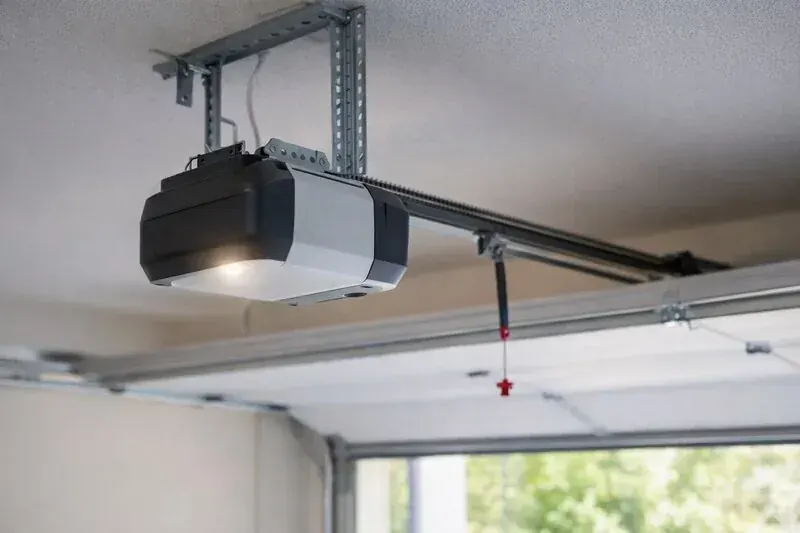
Yes. Architectural review covers the door itself — what is visible from the street. Opener brand, smart features, app control, battery backup, and remote technology are not regulated. We typically install LiftMaster 8500W jackshaft-style openers in historic Plaza homes because the original detached or attached garages often have low ceilings that don't suit overhead-mount openers.
Does the historic district require interior weatherstripping or insulation specs?
No. Architectural review boards in the J. C. Nichols districts regulate visible aesthetics. Insulation, R-value, hardware mechanism, and any interior detail is at homeowner discretion. We recommend insulated steel carriage-house doors (R-12 to R-18) for these older homes because the original detached garages are often uninsulated and full of thermal bridging.
What colors and finishes are typically approved in Country Club Plaza homes?
The CCHA approved-color list updates periodically but historically includes: Bridgeport (brown), Sandstone (tan), Almond, Charcoal, Black, certain dark greens (Hunter, Forest), and a small list of dark reds (Brick, Sienna). Bright modern colors (white, light gray, light blue, any high-saturation hue) are routinely denied. Faux-wood finishes have been approved more often in the last 5 years but still require case-by-case ARB review.
Can I install a glass-paneled or modern garage door in Sunset Hill or Greenway Fields?
Generally no on Sunset Hill and Greenway Fields. The character of these specific districts is more conservative than the Plaza commercial district. Glass-paneled and modern industrial-style doors are routinely denied for visible street-facing garages. Side-facing or alley-facing garages have more latitude. We have had some glass-accent carriage doors approved in alley-facing applications.
Historic District Garage Door Replacement
Same-day service across all of Kansas City Metro — Overland Park, Lee's Summit, Olathe, Shawnee, Liberty, Independence, Lenexa, Leawood, Prairie Village, Raytown, Blue Springs, and KCMO. Free written estimate. No service-call fee. Warrantied in Missouri and Kansas.
Call (816) 315-526124/7 Emergency · service@onpointprodoors.com
Related: New door installation → · Clopay carriage-house → · KCMO service → · Full FAQ →