
In a place like Phoenix or Los Angeles, the drive-type decision is mostly about noise preference.
Tell us what's happening. Free estimate, nothing owed.
In a place like Phoenix or Los Angeles, the drive-type decision is mostly about noise preference. Drive type meaningfully affects cold-weather performance, long-term wear, and homeowner maintenance burden. The KC freeze-thaw cycle puts the opener through 100 to 200 cold-weather cycles per winter, and each drive type handles those cycles differently.
Most KC homeowners installing a new opener today choose between belt-drive and chain-drive. Screw-drive is a third option that gets less attention - mostly because it's been declining in the broader US market - but it's still installed in older KC homes and homeowners ask about it when they're considering replacement.
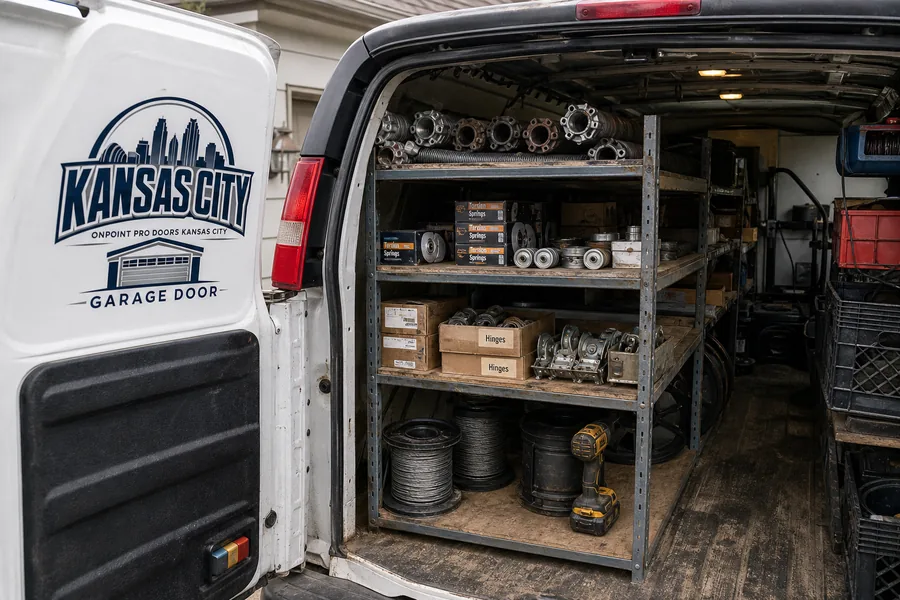
The same six jobs as everywhere else we work, with the parts for the doors common here already on board.

Belt-drive openers use a reinforced rubber-and-steel-fiber belt (similar to a car timing belt) to pull the trolley along the rail. The motor turns a small sprocket; the belt wraps around it and a pulley at the far end; the trolley clamps to the belt and moves as the belt moves.
For most KC homeowners installing a new opener today, belt-drive premium-tier is the right answer.
Excellent. The belt material is thermally stable from -40°F to +200°F - engineered to outperform KC's worst winter conditions. No lubricant required on the belt itself. No metal-on-metal contact to seize up. Motor draws normal amperage even on the coldest morning.
The quietest drive type by a meaningful margin. About 30 to 40 dB at peak (roughly equivalent to a quiet office). Chain-drive runs 55 to 70 dB at peak. The difference is dramatic when the bedroom is over the garage and someone is using the door at 6 AM.
Lowest of the three drive types. Just an annual visual inspection of the belt for tracking and tension. No lubrication of the drive mechanism itself.
Chain-drive openers use a metal roller chain (essentially a heavy bicycle chain) on a sprocket. The motor turns the sprocket; the chain travels along the rail; the trolley is attached to a section of the chain.
KC homeowners with detached garages in Liberty, Independence, or Excelsior Springs often pick chain-drive successfully - the noise isn't an issue when the bedroom is 60 feet away.
Very good. The chain itself is steel and operates at any KC temperature. Chain lubricant thickens below 20°F, which causes the chain to run noisier in cold, but mechanically the system keeps working. Chain-drive openers have been operating in cold-weather climates for 60+ years without major issues.
The loudest of the three drive types. Peak operation noise is 55 to 70 dB - about the level of normal conversation in the same room. The noise echoes through attached garage walls into the rest of the house. Chain-drive openers are a major source of "the garage door woke me up" complaints from KC homeowners with bedrooms over the garage.
Modest. Annual lubrication of the chain (white lithium spray, not motor oil) and visual tension inspection.
Screw-drive openers use a long threaded steel rod that rotates, with a carriage (trolley) that travels along the threads as the rod turns. The motor at one end spins the rod; the carriage spirals up and down the threads.
Poor compared to belt and chain. The screw thread is steel against a steel-and-plastic carriage, lubricated with a heavy grease that thickens significantly below 20°F.
Moderately loud and gets louder in cold. Cold lubricant causes the screw-and-carriage interaction to chatter and clunk. About 50 to 65 dB at peak in winter operation.
Highest of the three drive types. Re-greasing the screw every 6 to 12 months with manufacturer-specified lubricant is required. KC homeowners rarely do this - the maintenance is invisible (the screw is at the top of the garage where most homeowners never look) and gets neglected. Result: screw-drive openers tend to fail younger than belt-drive in our market, often around year 8 to 12 instead of 15 to 20.
Declining. LiftMaster has essentially exited the screw-drive market. Chamberlain doesn't offer screw-drive in current lineup. Genie still makes the Stealth Drive 750, available through some KC dealers and online. For the average KC homeowner, screw-drive is hard to find today.
Same-day service across all of Kansas City Metro - Overland Park, Lee's Summit, Olathe, Shawnee, Liberty, Independence, Lenexa, Leawood, Prairie Village, Raytown, Blue Springs, and KCMO. Free written estimate. Warrantied in Missouri and Kansas.
Related: Belt vs chain detail → · Opener installation → · LiftMaster service → · Frozen door fix →
Belt-drive is the best overall for KC winters. Reasons: silent operation (no chain noise echoing into the house from an attached garage on cold mornings when the house is otherwise quiet), no metal-on-metal wear, no lubrication-thickening issues at 10°F, and the longest reliable cold-weather lifespan. Chain-drive is a close second - mechanically simple and cold-tolerant but louder. Screw-drive is the worst for KC because the steel screw thread becomes sluggish below 20°F and requires regular lubrication that homeowners often neglect.
Belt-drive uses a reinforced rubber-and-steel belt to pull the trolley along the rail (similar to a car timing belt). Chain-drive uses a metal roller chain (like a bicycle chain) on a sprocket. Screw-drive uses a long threaded steel rod that rotates, and the trolley travels along the threads. Belt is quietest and most maintenance-free.
Yes. Belt-drive openers maintain their quiet operation across the full KC temperature range from 100°F summer highs to -10°F winter lows. The belt material is engineered for thermal stability and doesn't stiffen meaningfully in cold. Chain-drive openers get noisier in cold because the chain lubricant thickens and the rollers don't ride as smoothly. Screw-drive openers get the loudest in cold because the steel-on-steel screw threads become sluggish.
Almost never. Chain-drive is the most mechanically robust drive type. The chain itself is essentially a bicycle chain and operates fine at any KC temperature including the rare -10°F or colder snaps. What does happen in cold is the chain lubricant thickens, the chain runs noisier, and the motor draws slightly higher amperage. Long-term wear is unchanged. Cold doesn't kill chain-drive openers; surges and worn-out drive gears do.
Screw-drive relies on a steel threaded rod rotating against a steel-and-plastic carriage. Cold thickens the screw lubricant (typically a heavy grease) and increases friction between thread and carriage. Below 20°F, screw-drive openers run noticeably slower and louder. Most importantly, homeowners forget to re-grease the screw every 6 to 12 months - and un-greased screw-drive openers in KC winter degrade fast.
If your unheated KC garage has a screw-drive opener that's 10+ years old, yes - upgrade to belt-drive. We've replaced hundreds of old screw-drives with belt-drives across KC metro, and homeowners universally prefer the result.
Slightly. Heavier double-car insulated doors (which are common in newer KC homes) benefit from belt or chain drive in 3/4-HP or higher motors. Single-car doors work fine with any drive type. Carriage-house style doors with extra hardware weigh more and benefit from premium-tier belt-drive. For low-ceiling KC bungalows where overhead-mount won't fit, the better answer is a jackshaft (LiftMaster 8500W or Genie Wall Mount) which uses neither belt, chain, nor screw - it mounts on the wall.
One call gets you a two-hour slot and a heads-up call before the technician sets off. We don't buy leads and nobody on a phone judges a door they can't see.
Free estimate.
We need three things: a name, a number, and what the door is doing. Everything before you agree to it asks nothing of you, across the whole of Jackson County.
Quicker to talk? Call (816) 315-5261.
Tell us what's happening. Free estimate, nothing owed.